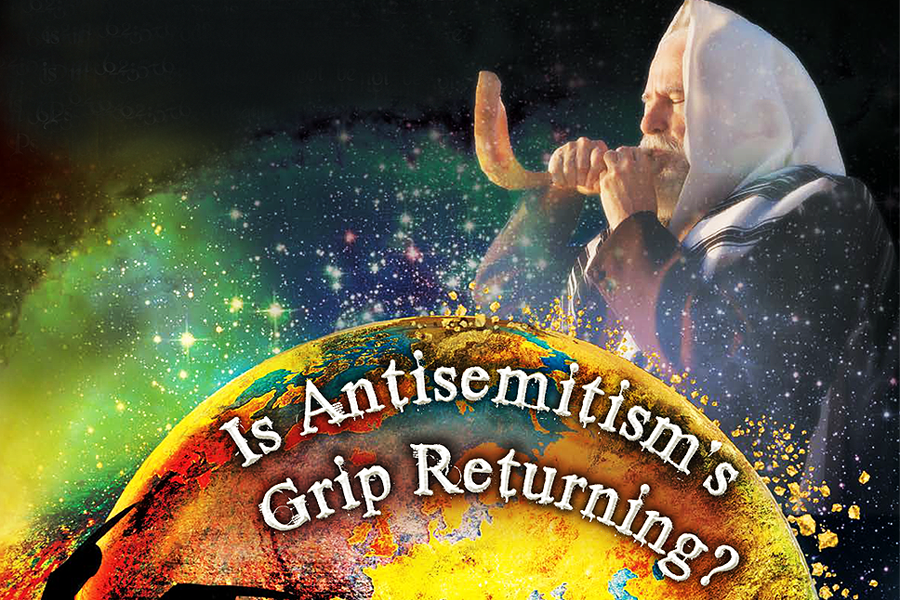
Over the centuries, the Jewish people have suffered terrible acts of violence, persecution, and overwhelming emotional distress. While much of the biblical narrative alludes to their relationship with a Holy God being at the center of terrible captivity and exile, it was their final dispersion to the four corners of the earth that scattered the Chosen people of God in the record of the biblical account. Yet after all of this time and with such a long history as a people, they still are dealing with the issues of persecution, prejudice and even hatred. In looking at the historical past, is the root of this type of prejudice ethnic, religious, racial, political, all the above or something more?
History’s anti-Semitic past
When the subject of anti-Semitism is brought up in dialogue, for most the immediate connection of the word is often to the Holocaust during WWII. Most of the world has been familiar with the history surrounding the persecution and eventual murder of more than six million Jews, with some scholars estimating eight million or more, during that time period. The Nazi regime under Hitler remains today as the most recent and vivid destructive means against the Jewish people in modern history. While the Nazis did have a military force fighting against the allied forces, it was the hidden shadows of the death camps where the most horrific casualties took place against innocent civilians simply because of their religion, their heritage, and their culture. This immense hatred of a single people group, as well as those who tried to help them, will forever be one of humanity’s darkest times.
Yet, the Holocaust was not history’s only revelation of the extremes of anti-Semitic prejudice and hatred that have been displayed against the Jewish people. A quick look at the definition of anti-Semitism in today’s dictionary finds the following: “hostility toward or discrimination against Jews as a religious, ethnic, or racial group” (Merriam Webster dictionary).
Antisemitism is hostility to, prejudice, or discrimination against Jews. A person who holds such positions is called an anti-Semite. Antisemitism is generally considered to be a form of racism…. Antisemitism may be manifested in many ways, ranging from expressions of hatred of or discrimination against individual Jews to organized pogroms by mobs, state police, or even military attacks on entire Jewish communities. Although the term did not come into common usage until the 19th century, it is now also applied to historic anti-Jewish incidents. Notable instances of persecution include the Rhine-land massacres preceding the First Crusade in 1096, the Edict of Expulsion from England in 1290, the massacres of Spanish Jews in 1391, the persecutions of the Spanish Inquisition, the expulsion from Spain in 1492, the Cossack massacres in Ukraine from 1648 to 1657, various anti-Jewish pogroms in the Russian Empire between 1821 and 1906, the 1894–1906 Dreyfus affair in France, the Holocaust in German-occupied Europe during World War II, Soviet anti-Jewish policies, and Arab and Muslim involvement in the Jewish exodus from Arab and Muslim countries. (Wiki – anti-Semitism)
Found throughout history we see over and over how this prejudice has cost humanity so much despair and so many Jewish families their precious lives and loved ones. The question remains however, is anti-Semitism rooted in culture, ethnicity, or religious differences alone, or is there a deeper meaning for the prejudice displayed against the Jewish People?
In the fourth quarter 2015 For Zion’s Sake, Sharon Sanders provided a unique understanding of the anti-Jewish rhetoric found within the writings of the early church fathers. She wrote: Volumes of slanderous talk addressing the Jewish people came also from the lips of Christendom’s forefathers who influenced Christian communities all over the world. Sermons given by Church Fathers assisted in the spreading of lies about the Chosen People and damaged hearts—people ended up prejudiced against the Jewish people from drinking barrels of “tainted wine”.
Epistle of Barnabas: “Take heed to yourselves and be not like some…saying that the covenant is theirs as well as ours. It is ours, but they lost it completely just after Moses received it.” “The custom of circumcising the flesh, handed down from Abraham, was given to you (Jews) as a distinguishing mark, to set you off from…us Christians…that you might suffer the afflictions that are now justly yours…and…God imposed upon you the observance of Shabbat as a mark.”
Justin Martyr: “The Jews…have committed the most abominable of crimes, in forming this conspiracy against the Savior…”
Origen: “The synagogue is worse than a brothel…the temple of demons…the cavern of devils…I hate the Jews…”
John Chrysostom: “How I wish that you would slay them (the Jews)…”
St. Augustine: Known as “the meekest of Christian men, he said: “How I wish that you would slay them (the Jews) with your two-edged sword, so that there should be none to oppose your word!”
Peter the Venerable: “…I doubt whether a Jew can be really human…”
Martin Luther: Their synagogues should be set on fire…their homes should likewise be broken down…deprived of their prayer-books…their rabbis must be forbidden under
threat of death to teach…next to the devil, a Christian has no more bitter and galling foe than a Jew….”
Is anti-Semitism rising again?
Since the miraculous rebirth of the nation of Israel in 1948, an ugly hand of Islamic hatred and prejudice against the Jewish people can be seen quite clearly by most. The Jewish nation returning to its original ancient homeland has indeed had a profound effect on the entire Middle East region. Adding to that the amazing Israeli victory in the Six-day war of 1967 to re-unify the city of Jerusalem under Jewish control, the Middle East neighborhood has become a regular place of aggression and violent hostility against the Jewish nation.
When anti-Semitism makes world headlines today, it usually is reported as some form of physical violence or political rhetoric. Whether it is Jewish gravesites that have been vandalized with painted Nazi swastikas, or Synagogues that have been damaged or destroyed, the physical violence has continued. Yet, the most violent attacks upon our Jewish friends are revealed in massacres like the violent October 2018 attack on the Pittsburgh synagogue where a single gunman killed 11 people and wounded seven more. Beyond the physical damage and death inflicted upon innocent lives, the true stain upon us all is a reality that a hatred, once manifested in the heart of an individual can be turned into an act of senseless violence that destroys so many lives, including those surrounding the victims and their communities.
Even the secular media is speaking about anti-Semitism and how it just won’t seem to leave, especially in the continent of Europe. A major global news service conducted a survey last year among nations in Europe concerning the Holocaust. Their survey showed that around one third of Europeans know either just a little or nothing about the Holocaust. Other comments from the survey pertained to opinions about Jews having too much influence in business, finance, media and politics.
The rise of anti-Semitic tone and rhetoric seems to also be reaching into the political arenas of Western nations. Heavily reported was last year’s media coverage on the UK Labor party, headed by Jeremy Corbyn, with accusations of anti-Semitic rhetoric being displayed often. Also, in the US Congress, the newly elected House Representative from Minnesota, Ilhan Omar recently faced allegations of anti-Semitic rhetoric that had secular media quoting government officials, members of Congress, and even the Vice President about her comments.
With all of the historical reference concerning the Jewish people over time, how is it that so many facts appear to be fading from the understanding of those in the very nations where the Holocaust took place, as well as the nations that came to the aid of those who survived those atrocities? Is it possible that the new atmosphere goes beyond the traditional Holocaust denial rhetoric, and is becoming a situation of historical fact fading from the pages of reference for those in the secular world around us?
Is anti-Semitism a spiritual issue?
The possibility exists that the underlying issues concerning anti-Semitism are actually spiritual in nature. Is it possible that prejudice and hatred of the Jewish people are an expression of a world that simply doesn’t want to believe what is written in Scripture? The thought of a Holy God choosing a people to call His own could generate a lot of emotional response in those considered as “not chosen.” Perhaps it could even generate a need to replace what God intended with a more human philosophical approach. What would make them so special to be “chosen” after all?
While Scripture clearly shows God’s promise to Abraham in Genesis 12:2-3, “I will make you into a great nation, and I will bless you; I will make your name great, and you will be a blessing. I will bless those who bless you, and whoever curses you I will curse; and all peoples on earth will be blessed through you.” It also indicates that this is something Abraham is not providing for himself. It is something that God is doing for him and through him. While the promise indicates that blessing will flow to “all peoples on earth,” it is through Abraham’s descendants that the blessing will flow over time. Since the beginning of creation, God has planned and purposed all things by His word. Scripture shows that the fall of mankind in the garden brought sin into the world. Yet even to-day the world is trying to negate that biblical account. Dr. Den-nis Lindsay, the President and CEO of Christ for the Nations in Dallas, TX, shares his thoughts with students about how the theory of evolution was introduced as a means of eliminating God from the equation. After all, Dennis teaches, if God didn’t create the world, then there really is no such thing as sin, if there is no God. And if there is no sin, then why would we ever need a savior? He feels that trying to prove there is no God of creation is simply a way for today’s humanistic society to question a need for salvation in the first place.
Fools say in their hearts, “There is no God.” They deal corruptly, their deeds are vile, not one does what is right. (Psalm 14:1 CJB)
Is it possible that the onslaught against the Jewish people is simply an onslaught against God himself? From a spiritual aspect, could it be that the spirit behind anti-Semitism, anti-Zi-onism, anti-Israelism, is the same spirit of denial that God is who He says He is? Could it be simply that the very existence of the Jewish people and the nation of Israel is a shining bea-con showing the world that God is who He says He is, that He keeps His promises, and His word is indeed truth?
Why God chose the Jewish nation as His people remains a mystery even to them, but the scriptural facts showing that he did remain as well. Scripture records that He chose a people to be separate unto Himself. As many around the world continue to study the word of God for themselves and see the importance of Israel and the Jewish people returning to their ancient homeland, rebuilding their nation, being a strong and blessed people, once again turning their face to the God of Abraham, Isaac and Jacob, we should all be encouraged that the God of creation is still on His throne, He keeps His promises, and the Messiah is soon to appear.
As Christians in the nations, our need to speak out against the onslaught of anti-Semitism, BDS, and all other attacks against the Jewish people and the nation of Israel is imperative in standing biblically aligned with the God whom we serve. If we understand that our Holy Scriptures, the prophets of old, our Jewish Messiah Jesus and his disciples are all from a Jewish heritage and family, then we must stand alongside them today in their times of greatest need. We must do our part to push back the increasing grip of anti-Semitism around the world. We must help in waking up our own Christian family around the world to the understanding that our faith is wholly and completely connected to the root of the scriptural heritage of the Jewish nation, and that the God we all serve is the one True God of the Bible–the God of Abraham, Isaac, and Jacob, the God of Israel.
Kevin Howard