Charles Spurgeon said “people read the view of their denominations…they read the views of their leader…but…the divine fountain-head from which all revelation wells up – this is too often left out…read the books, by all manner of means, but especially the parchments…” (Spurgeon).
Between the covers of the Book of Books lay vested, sacred Hebrew scrolls. These words of God, given through the Prophets of Israel, were priceless to Shaul (Paul) and they likewise, should be to Christians today.
Written by the Hand of God, these scrolls masterfully express His heart of love and mercy for a nation with a destiny of bringing light to the nations. From the stroke of each scribe’s pen came the Memra (in the sense of the directive Word of God…in Greek “logos”). “They are called Torah, the first five books of the Bible, which comes from the same root as Horeh which means parent…”. (Avi Lipkin) The books of the prophets are called Tanakh and all are inspired by the Almighty.
Each Jewish prophet wrote with pen in hand meticulously, as His Words were delivered by the Holy Spirit. Now, translated into many dialects and vernacular languages, the words still leap off the pages of Bibles into the hearts of believers around the world. Yet, it is quite common for many Christians to never open their Bibles to the “scrolls” of the books of Isaiah, Jeremiah, Joel, Amos and others.
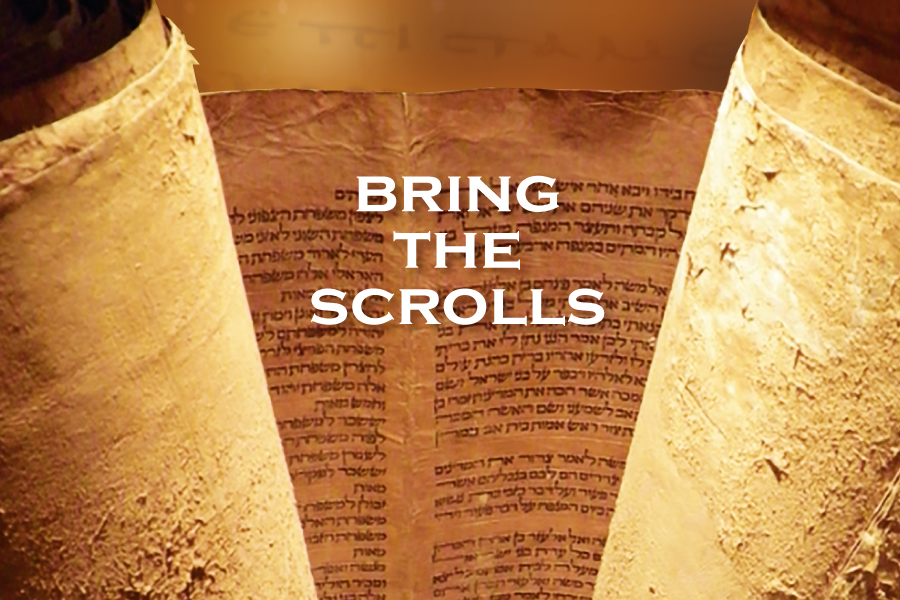
BRING THE SCROLLS
After his arrival in Troas (a chief northwest city in Asia Minor), Paul thought it extremely important to ask for his scrolls. This would be normal for a man of God who needed to continue his studies and besides, how could one teach if they didn’t have their scrolls with them? Likewise, how can Christian scholars, pastors and leaders assist their students in understanding a passage in the New Testament, correctly and in context, if they don’t know the Hebrew Bible which at one time were only on scrolls? It is my prayer that this article will provide a new appreciation for that which is too often neglected treasure in the Christian church today.
The word for “scroll” in Hebrew is megillah such as the Megillah of Esther or Ruth. In Yeshua’s day, scrolls were made of parchment paper that unrolled and opened out. As today, they expose one page at a time for reading, the scroll’s remaining pages then roll to the left and right of the visible page. Unrolled from side to side, the text is written across in lines from the top to the bottom of the page, reading from right to left.
Scrolls first began to be used by Hebrew scribes after Sinai, in the recording of literature. Special ink from lampblack (powdered carbon produced from burning oils) was collected and mixed with the juice of plants. If too many letters were lost, a Torah scroll was then no longer used (as today). Two types of pens, one of iron or wood and one much softer, made of reed were used. One thing is certain: scribes, sages and ordinary God-fearing Jews preserved and defended these sacred writings whenever danger was nearby.
Why is it so important to know about the Scrolls? I would like to share my observations regarding today’s Church. Pastors have personally asked me, “Should we be teaching the “Old” Testament? Dr. Marvin Wilson answers that question: “The bedrock upon which New Testament faith rests securely…is the Hebrew Bible…it is the chief source from which our common Judeo-Christian heritage derives. It was certainly an unfortunate day for the Church when the Jewish Scriptures began to be called the ‘Old Testament.’ Such a title implies that this Testament is now passé…neither Yeshua nor the apostles ever declared the first thirty-nine books of Sacred Scripture dead or abolished, and they must never become so for the Church….” Bible scholar Emil Brunner agrees: “…the Scrolls can scarcely be overestimated…they are the parent of the new…”
“Understanding this imperative is important if one is to grasp the Hebraic foundation which underpins the theology of the earliest church…for Christianity has been debtor to the Jewish people for sharing this rich legacy. But it is tragic to realize that many Christians have avoided the Old Testament as a matter of ignoring it. Wherever I travel, typically, Christians have received little emphasis on the Old Testament sermons, Sunday school teaching, and group Bible study. They have come to believe that the Old Testament is, for the most part, boring and irrelevant…” (Marvin R. Wilson, Ph.D.).
“…One of the first heresies that the Early Church faced was propounded by Marcion…a wealthy ship owner from Sinope (now northern Turkey), who in Rome began to argue that the Old Testament was inferior to the New and…fought to have it removed from the canon…the New Testament…Marcion insisted, revealed the true God in the coming of Christ from heaven…this God was a God of love. Marcion argued that the New Testament, being Christ’s book…was superior to the Old Testament…” He then demoted the Old Testament…and began to extol the writings of Paul, which held that Christians were “free from the Law” (Galatians 5:1)…he contended that the Church was wrong in attempting to combine the gospel with Judaism…his goal [was]…to rid Christianity of every trace of Judaism…he became known as the archenemy of the “Jew God”…Justin Martyr, a Church father, considered Marcionism to be the most dangerous heresy of his day.” (Marvin R. Wilson, Ph.D.)
SHOULD WE TEACH OLD TESTAMENT?
We yet have another problem that arose which the Early Church Fathers had to solve: the problem of what to do with the Old Testament…the Church had superseded Israel, they said. Now the “new Israel” laid claim to the Scriptures as theirs and through allegory, the Old Testament could be made a “Christian” document…and then proceeded to wrench the Biblical text from its plain historical meaning. When Christians pick and choose what to read in the Bible (especially New Testament Only churches) they end up with selective Bible reading and sever the Hebrew roots of the Christian faith.
“Neo-Marcionism..tends to be advanced when…they say…we don’t have anything to learn from you and your dead, legalistic religion, but you’ve got everything to learn from us.” A Pastor at last year’s CFI Conference, held every spring in Jerusalem, was upset because we invited a wonderful Jewish educator to speak on our platform. In a very annoying way he said, “how can they teach us anything?”
Such an attitude smacks of an exclusivism and elitism that can only further fortify the barrier that has divided Synagogue and Church since the First Century…we must…continue urging a return to the position of the Early Church, where today’s Christian can claim the Old Testament, as the New Testament did, for it belongs to us no less than it did—and does—to Israel.” (John Bright)
“Indeed, the Christian has through Christ in the truest sense been…grafted into Israel like a wild branch onto a cultivated tree (Romans 11:17-24). He must therefore see the Old Testament history as…the history of his own heritage of faith, its God as his God…the Christian who refuses to see it so, flies in the face of the New Testament’s witness and does no less than reject his own past…the Old Testament (the Scrolls) are foundational, not optional…and must hold a central place in the life of today’s Church. Can we afford to view the scrolls with any less esteem than did Yeshua, Paul, and the early believers?” (Dr. Marvin R. Wilson).
Paul obviously felt the writings were something he really needed. Our Jewish Lord adhered to the scrolls meticulously all His life…why wouldn’t Paul? When Yeshua comes again, won’t the “law go forth from Zion”? When He rules the world from Jerusalem He will teach us of His Ways. May we gain a new perspective about the Scrolls which were called for by Paul. While teaching in the synagogues, Yeshua “was handed a scroll of Isaiah and He read from it” (Luke 4:17). In Paul’s Jewish upbringing, he had been educated at the feet of Rabbi Gamaliel, where God’s Words were highly esteemed. Scholars say that Paul’s earnest request to Timothy to “bring the scrolls” was one of his final wishes on record. His cry must be ours. We must not be content if we do not have the entire Bible with us. I found on recent trips abroad, that carrying an actual Bible to church is a thing of the past. I often didn’t see one Bible in a meeting…everyone was on electronic iPads or cell phones attempting to find the Scriptures. No more reading the “Book”—many now read only from electronic devices. What happens if they stop working?
IT IS WRITTEN…HAVE YOU NOT HEARD?
I also learned that few Christians read the Bible on a consistent weekly study basis. They say, “I just don’t have time” or “I have lots of pressure at my job.” The same people run up to a Jewish person when they visit Israel and say to them: “Why don’t you believe in Jesus, you are blind!” and my Jewish friends tell me, “They don’t know how much that hurts because I study the Scriptures five hours a day!” It further amazes me that some Pastors and Christians do not know how to find books in the Old Testament. Yeshua rebuked His disciples and those who questioned Him saying “It is written,” “Have you not heard?,” “Have you not read?” obviously referring to the Scrolls. He certainly had no problem referring to them, and would most likely be very perplexed today at why we often don’t know them. The fact is that they are the inspired Word of God and foretold of Yeshua’s first coming. At lunch recently in Jerusalem with an Orthodox Jewess I quoted from the New Testament the words of Yeshua: “I have not come to destroy the law but to fulfill it” (Matthew 5:17). This Orthodox Jewess agreed that indeed Yeshua had spoken these words and wondered why Christians do not take Him earnestly.
While in Latin America, I was asked by leaders in Mexico City, “What if we do not read or teach the “Old” Testament? My response was that God had warned us about this very issue. “All Scripture is given by inspiration of God, and is profitable for doctrine, for reproof, for correction, for instruction in righteousness,” (2 Timothy 3:16) All Scripture means each and every one. I also said that by not reading the Hebrew Scriptures, we could be guilty of eliminating portions of God’s Word which could bring serious consequences. “For I testify unto every man…if any man shall add unto these things…and if any manshall take away…” (Revelation 22:18).Deuteronomy 12:32 agrees with Revelation 22 stating “…thou shalt not add thereto, nor diminish from it.” I find that in an beautiful way both Testaments cross reference and pay tribute to one another. Each gives the other spiritual strength needed for the true meaning of the passages. Yeshua declared publicly “Think not that I am come to destroy the law, or the prophets: I am not come to destroy, but to fulfill…one jot or one tittle shall in no wise pass from the law, till all be fulfilled. Whosoever therefore shall break one of these least commandments, (which includes adding to or taking away from) and shall teach men so, he shall be called the least in the kingdom of heaven…” (Matthew 5:17-19). He was essentially saying, “Don’t even form thoughts in your mind, that I came to earth to rescind the principles set out in the Hebrew Bible. They are the basis for the system of rules and knowledge with which I was educated and which I taught My Disciples.”
NEW TESTAMENT BUILT ON TORAH
It might be interesting to know that the New Testament contains at least 295 quotations from the Hebrew Scrolls. Yeshua was constantly reinforcing them. Yes, the Hebrew Scriptures are the rock by which the New Testament is supported. Personally, I see that the Hebrew Scriptures contain the love of God for a People: Israel. Also the New Testament carries on this great love for us, because as gentiles we are included in the true Israel of God. We need to rejoice that Yeshua came to meet the requirements of the prophecies in the scrolls… having reached the expected end – His Death and Resurrection. He accomplished and finished what had been written about Him. “Rolling up the Scroll, He handed it back to the attendant and sat down…He said to them, today this Scripture passage is fulfilled in your hearing” (Isaiah 49:6-9; 61:1,2).
Christian theologians for 20 centuries often cast aside these priceless parchment scrolls which described the origin and family of the Lord, and ended up hiding who He was in His Manhood. Spiritual darkness set in during the Dark Ages and unfortunately, still today, too many Christian churches still remain “in the dark.” Let us always remember that the Lord referenced words from the Scrolls in His prayers, He quoted from them on the cross and in His resurrection glory. That is why we have no authority to depart from them.
“Four thousand years ago, the Jewish people were the vessels into which God poured His Word. Nearly two thousand years ago, the Judaism of Jesus laid claim to the authority of the Hebrew Scriptures. The foundation of Christianity must be Judaism or it has no foundation. (Qumran Bet Community).
All SCRIPTURE MUST BE RESPECTED
It is time that the Hebrew Scriptures be given the respect they deserve by the Christian Church. Among the early followers of Jesus there was no “Christian Bible”—only the Scrolls. The New Testament had not yet been written, canonized nor distributed. The Hebrew Scriptures were the original authority from which believers pulled wisdom to support their arguments, or to help explain the gospel of Jesus Christ.
We must stop looking at the first part of the Bible as “their books” and the second part of the Bible as “our books.” Together they constitute one essential story. If we know nothing about the ancient Jewish ritual of animal sacrifice, which fully explained a need for blood atonement, we will not completely understand what Yeshua actually accomplished on the Cross. He completely fulfilled what was necessary, with His own spotless blood, to satisfy the Lord’s requirements for atonement written about in the Scrolls. The grandson of Rabbi Eliezer Ben Yehuda, the Father of the Hebrew language, spoke to our CFI staff recently. He said “You can destroy a scroll but you cannot destroy the words on it because the words live.”
To help us along our spiritual journey of understanding our Hebraic roots, we must recover the Biblical perspectives of the early believers. “…The Ethiopian Orthodox church, resisting the pressures of Hellenization and Latinization, has preserved a historical Torah-observant expression of the Christian faith… free of Marcionism…if the thinkers and pastoral shepherds of the Reformation in Europe had known of the existence of Johannine theology, their zeal would likely have focused on restoring the Church to the faith of the first Jewish believers…the classical Jewish writings…are the literary products of a dynamic process of Divine inspiration…in seeking to provide an…exegetical model that will help us rediscover the beauty of the Hebraic roots of all Christianity, an analysis of Johannine theology will be of more than passing interest for the Restoration Movement (Johannine theology is an historical school of New Testament exegesis)…the theological framework…of the Ethiopian Tawahedo Church…was never filtered through European thought processes…Paul…throughout his life confirmed the Torah and his adherence to it. He lived and died a Torah-observant Jew and expected the same high standard of ethical conduct from others.
Yet he forthrightly denounced fellow Jewish believers who taught that salvation was dependent upon acceptance of ‘ol ha-shamayim,’ ‘the yoke of heaven,’ the practical performance of the 613 Biblical commandments…Paul knew it was impossible to comply with all the stipulations of the Torah and as a mature student of Rabbi Gamaliel…the profundity of Paul’s rabbinic learning led him…to a single, inescapable conclusion, as he noted in his letter to the believers in the Jewish community of Rome: “Therefore we conclude that a man is justified by faith apart from the deeds of the Torah…do we then make void the Torah through faith? God forbid! Yea, we establish the Torah.” (Romans 3:28, 31). (Princess Esther Sellassie-Antohin, great-grandchild of Ethiopian Emperor Haile Sellassie I.)
The next time we look into God’s Word, let’s make sure we read the whole Bible and be sure we study the Scriptures but especially not to forget the “parchments.”
-Sharon Sanders-