
Passover and Passion

What day of the week was Jesus crucified? Traditionally, the Christian world has chosen Friday as it is the day before the weekly Sabbath. But were there other days in Passover week that were Sabbaths? How do we reconcile the fact that the “Last Supper” was a Passover meal (Luke 25:15) and yet, a day later, the Jewish leadership were still hoping to eat the Passover meal (John 18:28).


Eschatology: A Tale of Two Futures Part 2

In the second part of the two-part series, Geoff’s focus is on Pre-Millennialism. He considers the hallmarks of Dispensationalism. In particular, most dispensationalists equate the coming great tribulation with “the time of Jacob’s trouble”. In many schemes, this follows the “rapture of the church” and is, by definition, still in the future. Accordingly, the focus of the end-time tribulation is the nation of Israel to “bring it to its knees”. Geoff addresses this issue “head-on”, taking us through the chronological sequence which is Jeremiah chapters 30 and 31 which describes the return to the Land out of Holocaust, the establishment of democracy, the reclamation of the land, the promotion of Christian tourism and the encouragement of Christian intercession.

Eschatology: A Tale of Two Futures Part 1

This talk is the first part of a two-part series. In this first presentation, following a definition of “eschatology”, Geoff gives an overview of Church-centered eschatological schemes which can be broadly categorized as A-Millennial, Post-Millennial and Pre-Millennial views. The first question to be answered is whether the Millennium is literal or a symbolic concept. The entire Bible (both Old and New Testaments) speak of a Messianic Age on Planet Earth.

Resurrection and Rapture

The primary text for this talk is 1 Thessalonians 4:13-17 Brothers, we do not want you to be ignorant about those who fall asleep, or to grieve like the rest of men, who have no hope. We believe that Jesus died and rose again and so we believe that God will bring with Jesus those who have fallen asleep in him. According to the Lord’s own word, we tell you that we who are still alive, who are left till the coming of the Lord, will certainly not precede those who have fallen asleep.

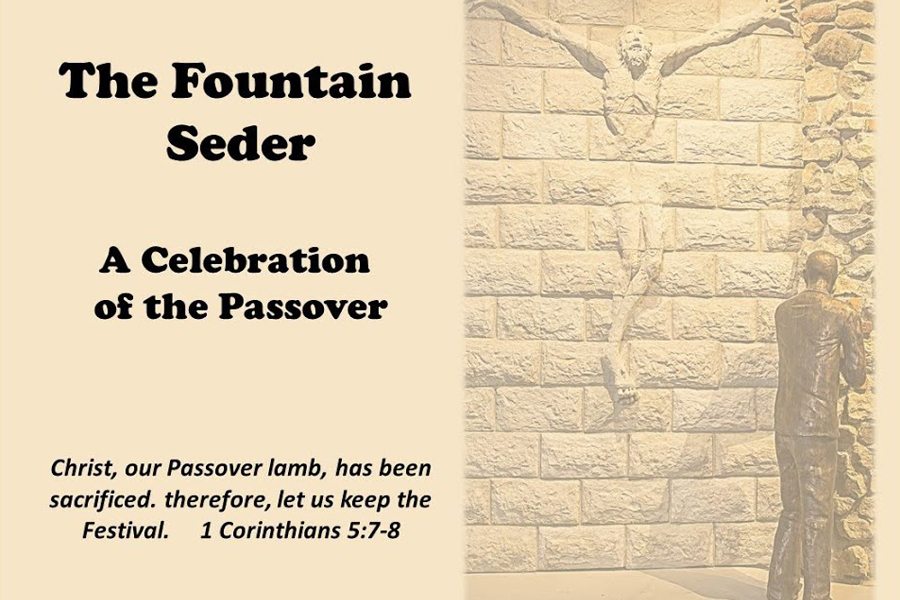
An On-line Seder

This on-line Seder was shared with friends over zoom. It stands on its own but follows a booklet that is available on request in the comments below. It is approximately two hours in length and includes music that is likely under copyright. I acknowledge the content and am grateful that YouTube will allow it. The video can be used as a full Seder with a break for a meal. It can be used in many other ways. The focus of this Seder is the person of Jesus.

Daniel’s Seventy Weeks

In this presentation, Geoff gives the historical context of chapter nine. Daniel is reading the prophecies of Jeremiah which were given in the fourth year of Jehoiakim, the first year of Nebuchadnezzar in 605 BCE. Daniel is reading these words around 538 BCE and he realises that the time is nearly up. He prays and the Lord answers by sending Angel Gabriel who gives him the outline of future history. In the New International Version of the passage, the angel says: “Know and understand this: From the issuing of the decree to restore and rebuild Jerusalem until the Anointed one, the ruler, comes, there will be seven ‘sevens,’ and sixty-two ‘sevens.’ It will be rebuilt with streets and a trench, but in times of trouble. After the sixty-two ‘sevens,’ the Anointed one will be cut off and will have nothing. The people of the ruler who will come will destroy the city and the sanctuary.

Beauty for Ashes Part 2

In this second part, we consider what occurred in the synagogue in Nazareth as recorded in Luke chapter four. Jesus is given the scroll and finds the place which is the equivalent of Isaiah chapter 61. What he says appears different from the way we read the passage in the Tanakh. Furthermore, the English version in the KJV (or the NKJV) is different from more modern translations. In particular, we might ask “What becomes of the broken hearted?” Did Jesus say anything about the broken-hearted in the synagogue?

Scroll to top